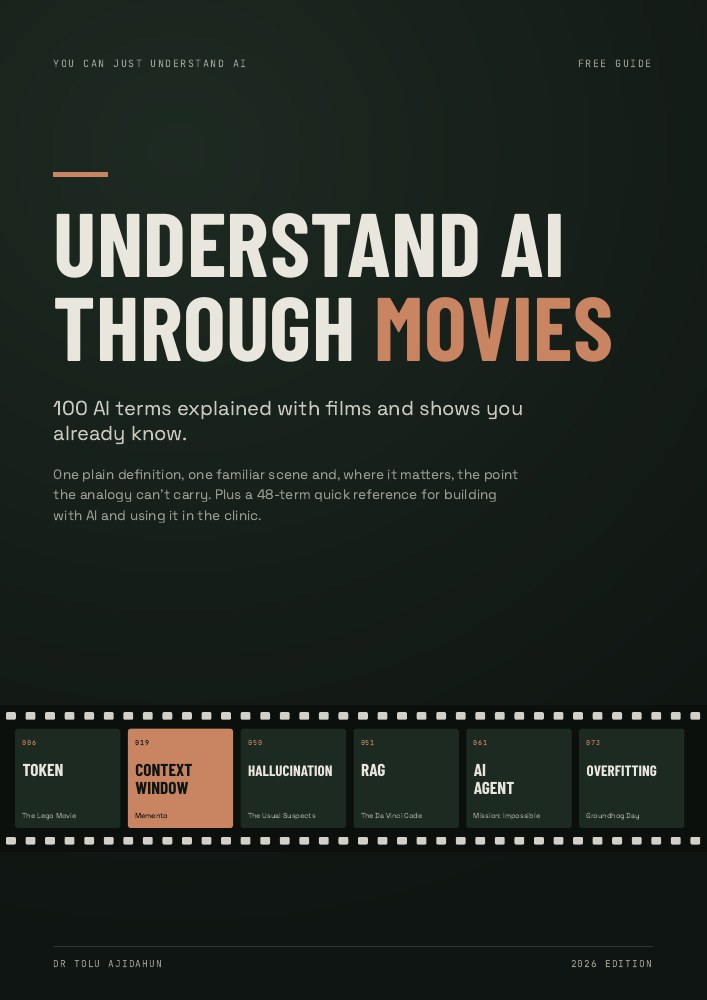
These comparisons are memory aids, not technical descriptions. Trust the definition when the two disagree. Film titles are references; this guide is not affiliated with any studio.
Context window
The maximum amount of text, counted in tokens, a model can work with in one request.
The scene: Memento. Leonard can only use what is in front of him now: his notes, photos and tattoos. Everything else is gone.
Keep in mind: Information outside the window does not exist for the model.
Training
Adjusting a model’s weights with examples and feedback so its predictions improve.
The scene: Rocky. The training montage. Every run and every punch changes what Rocky can do.
Inference
Using a trained model to produce an output. The weights do not change.
The scene: Rocky. The fight. Rocky uses what training built. He does not learn new skills in the ring.
Keep in mind: When someone says AI is expensive, ask which bill they mean: training or inference.
Hallucination
A fluent, confident answer that is not supported by facts.
The scene: The Usual Suspects. Verbal builds a convincing story from details on the notice board behind him. It sounds true. Much of it is invented.
Keep in mind: Fluency is not evidence. Check claims that matter.
Retrieval-augmented generation (RAG)
Search a collection of documents, put the relevant passages into the prompt, then answer from them.
The scene: The Da Vinci Code. Langdon does not answer from memory. He goes to the documents and reasons from what he finds.
Keep in mind: The answer can only be as good as the passage the search brings back.
AI agent
A system in which a model works toward a goal in a loop: plan, use tools, check the result, adjust.
The scene: Mission: Impossible. Ethan gets an objective, not a script. He plans, uses gadgets and adapts when things break.
Prompt injection
Hidden instructions inside content the AI reads (a web page, an email, a document) that try to change what it does.
The scene: Inception. Cobb plants an idea so it feels like the target’s own. A planted line in a web page can steer an AI agent the same way.
Keep in mind: This is a main security risk for agents that read the open web.
Overfitting
A model learns its training examples so exactly that it fails on new ones.
The scene: Groundhog Day. Phil memorises every detail of one day. That perfect script is useless on any other day.
Reinforcement learning
Learning by trying actions and receiving rewards or penalties, instead of being shown the right answer.
The scene: Edge of Tomorrow. Cage relives the same battle. Every death teaches him which move to avoid next time.